
How Data Analytics Is Transforming Modern Professional Sports
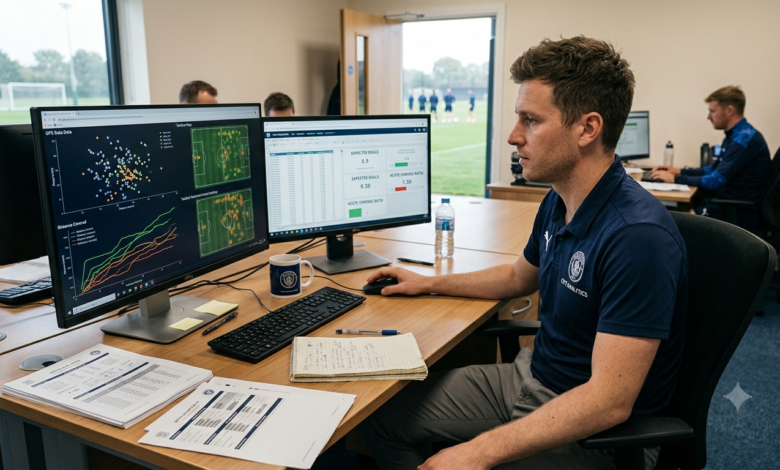
Professional sports were once governed almost entirely by intuition, traditional scouting eyes, and basic box-score statistics. Today, multi-million-dollar decisions on player transfers, tactical adjustments, and athlete health are driven by algorithms processing millions of data points per second.
From computer vision cameras capturing fine-grained body mechanics to high-frequency GPS wearables monitoring physical strain, sports data analytics has evolved from an experimental edge into the primary operational engine of modern athletics. With the global sports analytics industry expanding rapidly toward multi-billion-dollar market values, data is no longer just a tactical advantage—it is an absolute necessity for competitive survival.
What Is Sports Data Analytics?
Sports data analytics involves collecting, processing, and analyzing quantitative performance data from athletic events, training sessions, and administrative operations. It blends sports science, statistics, computer science, and video evaluation to provide actionable insights for decision-makers across a franchise.
The process functions in a continuous operational loop:
-
Data Acquisition: High-resolution cameras, optical tracking systems, micro-electromechanical sensors (MEMS), and biometric wearables record spatial coordinates, movement velocity, heart rate variability, and ball trajectories in real time.
-
Data Aggregation & Cleaning: Raw inputs—often reaching hundreds of gigabytes per game—are structured, normalized, and mapped to specific play events using automated pipelines.
-
Advanced Modeling: Machine learning models process historical and live data to calculate complex advanced metrics (such as expected goals, pitch movement profiles, or defensive coverage efficiencies).
-
Strategic Execution: Coaches, athletic trainers, and executives translate these statistical models into actionable tactical plans, personalized training loads, and transfer market decisions.
How Data Analytics Entered Professional Sports
The widespread adoption of analytics in elite sports traces back to baseball in the late 1990s and early 2000s, popularized by Oakland Athletics General Manager Billy Beane and writer Michael Lewis’s book Moneyball. Facing severe budget constraints, the Oakland A’s utilized sabermetrics—a statistical approach pioneering the replacement of traditional metrics like batting average with undervalued stats like on-base percentage—to outcompete far wealthier rivals.
The success of sabermetrics catalyzed a ripple effect across global sports:
-
Basketball: The National Basketball Association (NBA) underwent a shooting revolution after analytics proved that three-point shots and high-efficiency rim finishes yielded a vastly superior expected value per possession compared to mid-range jump shots.
-
Soccer: European football clubs moved beyond basic goal and assist tallies, adopting spatial optical tracking to evaluate off-ball movement, defensive lines, and expected goals (xG).
-
Baseball: Major League Baseball (MLB) introduced Statcast systems, shifting the focus from outcome-based numbers to pitch release metrics, spin rates, launch angles, and exit velocities.
How Teams Use Analytics to Improve Performance
Traditional statistics often evaluate past outcomes rather than underlying performance quality. Modern sports data analytics solves this by focusing on predictive and contextual metrics that strip away luck.
| Analysis Focus | Traditional Metrics | Advanced Data Metrics |
| Soccer / Football | Goals scored, assists | Expected Goals (xG), Expected Threat (xT) |
| Baseball | Batting average, ERA | Exit velocity, spin rate, launch angle |
| Basketball | Points per game, rebounds | True Shooting %, Player Efficiency Rating |
| Player Workload | Total minutes played | High-speed sprint distance, Acute-to-Chronic ratio |
Evaluating an athlete’s impact requires measuring what happens around the ball. In football (soccer), a player might log a high passing accuracy percentage simply by taking safe backward passes. Advanced metrics like Expected Assists (xA) and Progressive Passes evaluate how much a pass increases a team’s probability of scoring by breaking opposition defensive lines.
Data Analytics in Player Recruitment and Scouting
Transfer markets in professional sports involve massive financial risk. Recruitment departments utilize global data networks to identify undervalued talent while mitigating recruitment errors.
-
Algorithmic Scouting: Platforms index performance metrics from over 100 global domestic leagues. Scouts filtering for specific player profiles (e.g., a central midfielder ranking in the 90th percentile for pressures under pressure and progressive ball carries) can narrow down thousands of potential targets in seconds.
-
Market Inefficiency Arbitrage: Clubs with modest budgets locate hidden gems playing in lower-tier leagues whose predictive underlying numbers match elite-tier talent.
-
Replacement Modeling: When a star player leaves a franchise, analytics departments model how to replace their overall statistical production by hiring two or three specialized, cost-effective players rather than purchasing a single overpriced marquee replacement.
How Analytics Is Changing Coaching and Game Strategy
Coaching staffs rely heavily on pre-game and post-game analytical reports to structure tactical frameworks.
-
Tactical Adjustments in Real Time: In basketball, real-time spatial data informs coaches which defensive lineups successfully force opponents into low-efficiency floaters or long two-pointers. In American football, coaches utilize win-probability models on the sideline to make mathematically sound decisions regarding whether to attempt a fourth-down conversion or punt.
-
Set-Piece Optimization: In elite soccer, dedicated set-piece analysts use spatial clustering models to design corner kick routines. By mapping structural weaknesses in opposing zonal marking systems, teams routinely score key goals from calculated, high-percentage routines practiced during the week.
Injury Prevention and Athlete Health Monitoring
An injured star athlete represents both a tactical loss and a significant financial liability. Medical staffs rely on predictive biomechanical data to prevent strain-related injuries before they occur.
-
Acute-to-Chronic Workload Ratio (ACWR): Health specialists track an athlete’s short-term physical strain (acute load) relative to their four-week baseline preparation (chronic load). Sudden spikes in acute workload trigger alerts to adjust training loads before muscle tears occur.
-
Biomechanics and Motion Tracking: High-speed video analysis monitors body symmetry during movements like sprinting and landing. Asymmetries following a match indicate localized muscle fatigue, signaling to physios that a player needs targeted recovery work.
Wearable Technology and Real-Time Sports Data
Wearable technology forms the backbone of day-to-day data collection in modern elite training environments.
| Technology | Primary Metrics Tracked | Application |
| GPS Vests | Distance, acceleration, decelerations, sprint volume | Workload management and spatial mapping |
| Smart Rings & Bands | Heart Rate Variability (HRV), sleep cycles, body temp | Recovery monitoring and fatigue tracking |
| Cleat / Insole Sensors | Force output, contact time, movement asymmetry | Biomechanical evaluation and injury rehabilitation |
| Smart Apparel | Muscle activation patterns via surface EMG | Identifying muscle imbalances under fatigue |
AI and Machine Learning in Sports Analytics
Artificial intelligence and deep learning models are moving sports data analytics beyond descriptive statistics and into predictive analysis.
-
Computer Vision Tracking: Instead of relying on hardware worn by players, multi-camera arrays around stadiums feed automated computer vision systems. These systems identify player limb joints, ball rotation, and spatial movements up to 60 times per second, generating dense 3D visual data without requiring physical wearable tags.
-
Generative and Predictive AI: Machine learning algorithms process decades of historical game data to simulate thousands of tactical scenarios in seconds. Coaches can test virtual game plans against an opponent’s probabilistic tendencies before stepping onto the field.
How Analytics Is Changing the Fan Experience
Data analytics has moved out of back-office strategy rooms and directly onto consumer screens, reshaping sports media and fan engagement.
-
Enhanced Live Broadcasts: Networks integrate real-time spatial graphics directly into broadcasts—displaying real-time sprint speeds in football, shot probability arcs in basketball, and pitch trajectory visualizations in baseball.
-
Advanced Sports Betting: Sportsbooks rely on real-time data feeds to dynamically calculate in-game odds based on changing win probabilities and possession metrics.
-
Personalized Fan Content: Digital platforms utilize fan preference data to deliver tailored highlight packages, fantasy sports insights, and interactive live stats directly to second-screen devices.
Examples Across Major Professional Sports
Different sports utilize analytical frameworks tailored to their unique game rules and spatial structures:
-
Soccer / Football: Clubs leverage optical tracking and Expected Goals (xG) models to measure shot quality based on location, pass angle, and defender proximity. Expected Threat (xT) measures how much a player’s pass or dribble moves the ball into higher-scoring locations on the pitch.
-
Basketball: Analytic models reshaped modern basketball architecture. Advanced tracking tools monitor player fatigue, shot-efficiency zones, line-up combinations, and defensive coverage efficiency, resulting in a game dominated by three-point attempts, transition play, and spacing inside the key.
-
Baseball: Major League Baseball relies heavily on pitch velocity, spin rates, release points, exit velocity, and launch angles. The implementation of Statcast data transformed swing mechanics and defensive positioning strategies across the league.
-
Cricket: Data analytics shapes team selection and match management in formats like Twenty20 (T20). Analysts use pitch maps, ball-by-ball trajectory tracking, and matchup matrices to design specific bowling strategies against opponent weaknesses.
-
Tennis: Players and coaches analyze serve patterns, shot speed, break-point conversion rates, and court positioning maps to identify tactical weaknesses in opponents and optimize serve-direction selections under pressure.
Challenges and Limitations of Sports Analytics
While quantitative data provides clear advantages, over-reliance on metrics presents distinct challenges:
-
The Human Factor: Analytics models struggle to measure intangibles like leadership, emotional resilience, team chemistry, or performance under high psychological pressure.
-
Data Quality and Noise: Sensor calibration errors, missing tracking frames, or incomplete datasets lead to inaccurate algorithmic conclusions.
-
Data Privacy and Athlete Ownership: Wearables generate sensitive biometric data. Unsettled legal debates center on whether clubs have the right to use an athlete’s private biometric metrics during contract negotiations.
-
Over-Index on Numbers: Coaches who blindly follow statistical models risk ignoring on-field context, game flow, and human intuition.
The Future of Data Analytics in Professional Sports
As sports tech continues to evolve, several emerging shifts will define the coming years:
-
Real-Time Automated Officiating: Computer vision tracking systems will expand across global sports to handle offside calls, boundary lines, and foul calls instantly and accurately.
-
Hyper-Personalized Athlete Recovery: Integration of genetic testing, metabolic monitoring, and continuous biometric tracking will yield customized daily recovery, nutrition, and sleep regimens for athletes.
-
Neuro-Analytics: Measuring brain wave activity, visual reaction speed, and cognitive load will open up fresh frontiers in evaluating elite decision-making skills under stress.
Data analytics has permanently changed the landscape of modern professional sports. By replacing guesswork with verifiable metrics, analytical tools allow clubs to optimize performance, protect athlete health, make informed recruitment investments, and engage fans on deeper levels.
However, data is most powerful when paired with human experience. The most successful organizations moving forward will not be those that simply accumulate the most data, but those that successfully combine advanced technology with veteran coaching, sports science expertise, and human intuition.