
The Biggest Business Trends American Companies Are Watching in 2026
The Biggest Business Trends American Companies Are Watching in 2026
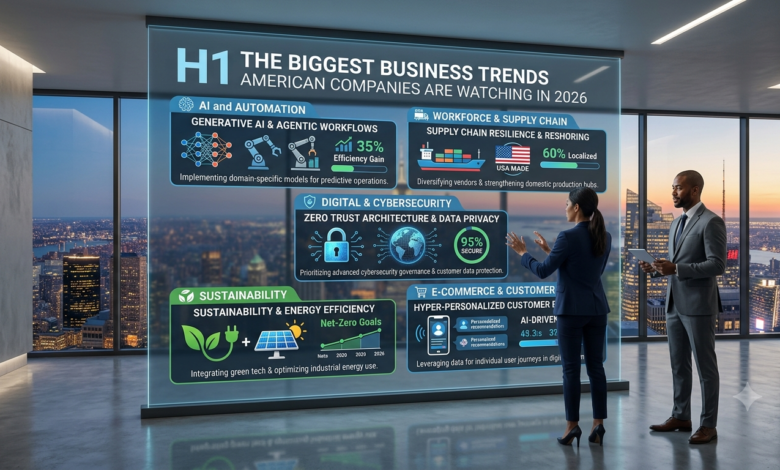
The American business landscape in 2026 is defined by a shift from speculative experimentation to disciplined execution. Following years of rapid tech expansion, inflationary pressures, and changing workplace dynamics, U.S. enterprises across all sectors are prioritizing operational resilience, tangible ROI, and sustainable growth.
Navigating the remainder of the decade requires leaders to balance technological integration with economic realism. From the deployment of specialized AI agents to the reshoring of critical supply chains, key macro trends are fundamentally altering how American companies operate, hire, and compete.
AI Is Moving From Experimentation to Everyday Operations
In 2026, corporate America has reached an inflection point with artificial intelligence. The phase of novelty deployments is over; enterprises are now demanding clear operational metrics and financial returns from their technology investments.
According to enterprise research from Gartner, organizational spending on AI models and platforms is projected to reach $2.52 trillion in 2026, representing a 44% year-over-year increase. However, executive focus has pivoted away from massive, generalized models toward Domain-Specific Language Models (DSLMs) tailored for industry-specific data.
| Phase | Core Characteristics |
| 2024–2025: Exploration Phase | Consumer LLM experimentation, dispersed pilot projects, uncapped R&D budgets |
| 2026+: Value Realization Phase | Domain-Specific Models (DSLMs), embedded agentic workflows, strict ROI & usage governance |
Why It Matters
Generative AI tools that merely generate text or summarize documents no longer provide a competitive advantage. Companies need systems that integrate directly into operational workflows—such as financial forecasting, automated underwriting, or predictive inventory management—while maintaining strict data governance.
Corporate Response
Businesses are auditing their tech stacks to eliminate redundant AI tools, consolidating around platforms that offer clear cost tracking and measurable efficiency gains.
AI Agents and Workplace Automation
Beyond simple copilot interfaces, 2026 marks the widespread arrival of agentic AI—autonomous digital systems designed to execute multi-step business workflows without continuous human prompting.
| Layer | Function & Purpose |
| Autonomous Execution | Resolves customer tickets & processes claims end-to-end |
| Human Oversight Layer | Establishes approval checkpoints for high-risk actions |
| System Integration | Connects directly into enterprise ERP & CRM databases |
These AI agents move beyond generating content to taking discrete actions:
-
Managing enterprise supply chain updates across disparate vendor portals.
-
Conducting preliminary compliance checks for financial transactions.
-
Resolving complex, multi-tiered customer support tickets end-to-end.
Research indicates that task-specific AI agents are rapidly becoming standard features within enterprise software suites. The central leadership challenge has shifted from deploying automation to establishing governance frameworks that audit agent decisions and mitigate operational risk.
Companies Are Rethinking Costs and Productivity
Persistent operational overhead and tight capital markets are driving American companies to adopt an aggressive focus on unit economics and cost optimization.
Rather than relying on revenue growth alone to offset rising input costs, executives are scrutinizing workflow bottlenecks. Technology spending is increasingly tied to immediate efficiency gains, automated resource allocation, and reduced cycle times.
Key Productivity Strategies for 2026
-
Software Rationalization: Eliminating overlapping SaaS subscriptions in favor of unified platform ecosystems.
-
Process Mining: Utilizing analytical tools to identify operational latency across procurement, hiring, and billing.
-
Capital Reinvestment: Redirecting realized efficiency savings directly into revenue-generating modernization projects.
Consumer Spending Is Changing Business Strategies
American consumers in 2026 are exercising deliberate value-conscious behavior. While employment levels remain steady, cumulative cost inflation over recent years has made buyers far more selective about discretionary purchases.
| Spending Dimension | Market Reality |
| Consolidated Spending | Selective discretionary choices, high sensitivity to price hikes, reduced tolerance for marketing fluff |
| Value-Driven Loyalty | Strong demand for upfront price clarity, prioritization of product durability, expectation of personalized ROI |
Consumers are rejecting surface-level marketing gimmicks and hidden fees, forcing brands to overhaul their pricing structures and value propositions. B2B buyers display a similar discipline, demanding clear proof of return on investment before signing or renewing vendor contracts.
The Workforce and Skills Gap Are Evolving
The modern labor market faces a structural dichotomy. While demand for routine, legacy administrative tasks continues to decline, the shortage of specialized technical talent has reached critical levels.
| Workforce Dynamic | Strategic Focus |
| Dynamic 1: Skilled Labor Demand | High demand for industrial machinery technicians, electricians, and cloud architects |
| Dynamic 2: Capability Building | Prioritizing internal upskilling over external hiring for digital dexterity and AI tools |
| Dynamic 3: Hiring Criteria | Transitioning to skills-based hiring over strict formal degree requirements |
Organizations are realizing that external hiring alone cannot bridge technical skill gaps. As a result, internal upskilling initiatives—focused on AI literacy, data analysis, and advanced equipment operations—have become core talent retention strategies.
Remote and Hybrid Work Continue to Transform Offices
The debate over remote work has matured in 2026. U.S. companies have largely moved past reactionary return-to-office mandates, settling into intentional hybrid operating models.
| Work Structure | Key Focus Areas |
| Collaborative Days (In-Office) | Cross-functional planning, mentorship, onboarding, and strategic alignment meetings |
| Focused Days (Remote) | Deep analytical tasks, asynchronous execution, and individual contribution work |
Companies are restructuring commercial real estate portfolios, downsizing square footage while upgrading the functional tech capabilities of physical offices. Hybrid policies are now treated as an operational system requiring clear guidelines for asynchronous communication, documented processes, and objective performance metrics.
Cybersecurity Becomes a Bigger Business Priority
As enterprises embed AI deeper into core databases and operational workflows, their threat surface expands exponentially. Cybersecurity in 2026 is no longer strictly an IT management task; it is a primary board-level governance requirement.
Companies face sophisticated threats, including AI-driven phishing attacks and data poisoning risks targeting corporate models.
| Security Pillar | Enterprise Objective |
| Zero Trust Access | Strict verification protocols for human and synthetic actors |
| Data Sovereignty & Privacy | Securing proprietary LLM inputs and enterprise IP |
| Third-Party Risk Audit | Continuous security oversight of global software supply chains |
Organizations are responding by implementing mandatory Zero Trust architectures, adopting quantum-resistant encryption protocols, and conducting rigorous audits of vendor software pipelines.
Supply Chains and Domestic Manufacturing
Geopolitical volatility and unpredictable global trade dynamics have made supply chain resilience a central corporate mandate.
Data from the 2026 USA Reshoring Survey Report shows that 36% of Original Equipment Manufacturers (OEMs) have reshored operations or are actively engaged in additional reshoring.
| Reshoring Driver | Percentage | Reported Operational Outcome | Impact |
| Policy Uncertainty | 57% | Speed to Market | 70% improved |
| Geopolitical Risk Exposure | 53% | Fulfillment Reliability | 65% improved |
| Market Pricing Impact | 15% | Logistics & Freight Costs | 60% saved |
To support nearshoring and domestic production, regional industrial hubs across the Midwest and Southeast are attracting substantial capital investments. Companies are accepting slightly higher domestic production costs to eliminate inventory disruptions and shorten customer fulfillment cycles.
Digital Commerce and Personalized Customer Experiences
E-commerce growth in 2026 relies on transactional speed, predictive discovery, and unified channel experiences.
Generic customer journeys are being replaced by dynamic interfaces that adapt in real time to consumer context and purchase history.
| Commerce Stage | Technical Execution |
| Contextual Discovery | Tailored product recommendations without privacy intrusion |
| Predictive Search | AI-assisted natural language product navigation |
| Frictionless Checkout | One-click fulfillment and transparent pricing structure |
Retailers and B2B sellers are unifying inventory databases across physical locations and digital stores, ensuring buyers experience transparent pricing, accurate stock counts, and rapid delivery options regardless of channel.
Sustainability, Energy Costs, and Business Efficiency
Corporate sustainability in 2026 has evolved from brand marketing into a strict cost and risk management strategy. Rising energy demands—driven in part by localized manufacturing expansion and data-center power requirements—have made energy efficiency a direct operational variable.
Tactical Sustainability Initiatives
-
Facility Microgrids: Deploying localized solar, storage, and smart-grid controls to insulate facilities from commercial grid instability.
-
Circular Supply Chains: Implementing recovery, refurbishment, and material reuse loops to offset raw material price spikes.
-
Data Center Efficiency: Partnering with cloud providers that prioritize low-latency, energy-optimized infrastructure.
Small Businesses and Entrepreneurship in 2026
Small businesses and startups are capitalizing on enterprise-grade software capabilities at a fraction of past historical costs.
By leveraging plug-and-play cloud platforms, low-code automation tools, and targeted AI systems, small teams are operating with the output velocity of large companies.
| Operational Area | Tactical Implementation |
| Marketing & Discovery | Hyper-localized programmatic ad campaigns |
| Operations | Automated inventory management and automated reconciliation |
| Customer Service | AI-assisted support workflows and instant resolution |
| Talent Acquisition | Global fractionated contractor pools and specialized gig talent |
However, small business owners face challenges from elevated commercial interest rates and tight credit terms, making disciplined cash flow management and early profitability essential for long-term viability.
What American Companies Should Watch Next
Looking ahead past 2026, enterprise planning requires balancing agility with strategic capital allocation. Leaders preparing for the next operational cycle must monitor several emerging factors:
| Strategic Pillar | Focus & Key Indicators |
| Regulatory Compliance | Adapting to evolving state and federal AI governance standards |
| Grid Infrastructure | Managing power loads and grid capacity for compute and industry |
| Workforce Demographics | Addressing structural skilled labor shortages through vocational pipelines |
The theme connecting American business trends in 2026 is purposeful execution. Companies are no longer pursuing technology for tech’s sake or expanding headcount without clear operational models. Success in this environment belongs to organizations that integrate intelligent automation into reliable workflows, protect data integrity, optimize supply chains, and deliver authentic, transparent value to consumers.
